A floor is the largest single surface in a home and the one thing every other finish has to agree with. Get it right and the doors, the joinery, the stair and the furniture fall into place around it. Get it wrong — the wrong board for a villa in Dubai, the wrong subfloor preparation, the wrong finish — and you live with cupped boards, hollow-sounding rooms and gaps that open every summer.
At Fitout | Renovation Dubai we supply and fit wooden flooring Dubai homeowners actually live on: engineered oak and walnut planks, solid hardwood, herringbone and chevron parquet, wide-plank and long-plank floors, SPC, LVT and high-pressure laminate where a real timber floor is not practical, and the sanding, staining and re-finishing of floors that are already down. We also make the parts most flooring companies leave out — matching skirtings, thresholds, stair nosings, door bottoms and shadow-gap details — in our own workshop in Ras Al Khor.
Since 1984 our team has laid floors in villas across Jumeirah, Emirates Hills, Arabian Ranches and Dubai Hills, apartments in Downtown, Marina and Palm Jumeirah, and offices, showrooms and hotels across the Emirates. This page explains what we fit, how a floor has to be built to survive Gulf conditions, what it costs in 2026, and the questions clients ask before they commit to a floor they will walk on for the next fifteen years.
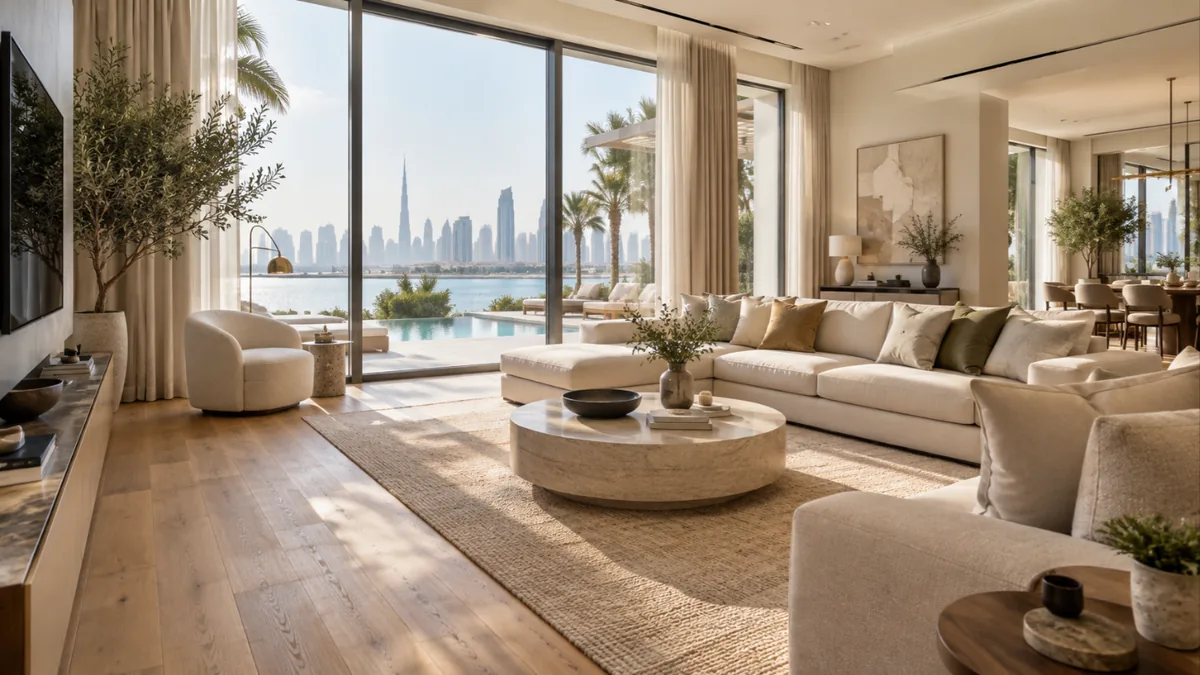
Most flooring problems in Dubai have nothing to do with the timber and everything to do with what is underneath it. Villa and apartment slabs here are poured fast, often finished with a screed that is still holding construction moisture months later, and rarely flat to the tolerance a timber floor needs. Lay a beautiful board over that and it will telegraph every hump, creak at every hollow and, if the slab is damp, cup within a season.
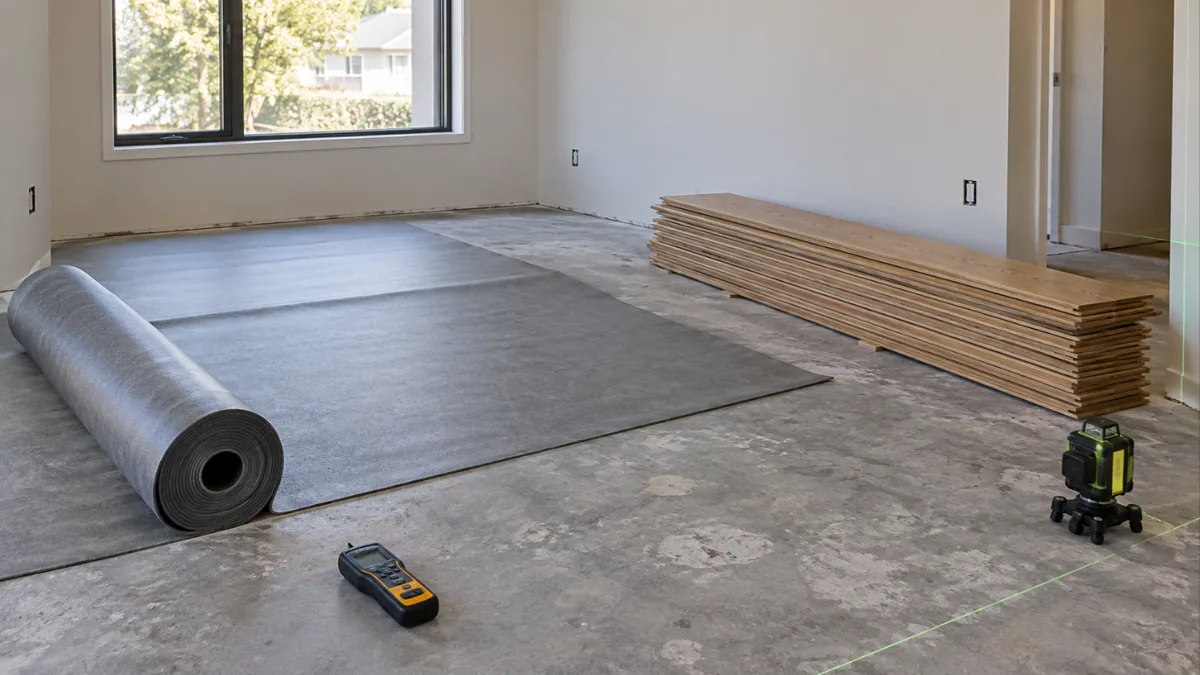
So we start underneath. Every floor we quote begins with a moisture reading of the slab or screed, a flatness survey with a straight edge and laser, and a decision about the build-up: a damp-proof membrane where readings demand it, self-levelling compound where the slab is out of tolerance, acoustic underlay to meet building rules in apartments, and the right fixing method — fully bonded, floating or secret-nailed — for the board and the room.
The second decision is the board itself. In air-conditioned Dubai interiors, engineered boards with a multi-ply or plywood core are the safest choice in almost every case: the cross-bonded core resists the shrinkage that dry air causes, so wide planks stay flat where solid boards of the same width would move. Solid hardwood still has a place — in rooms with stable humidity, in narrower widths, and where a floor will be sanded many times over decades — and we will tell you honestly which one your room wants.
The third is the detail at the edges. A floor is judged where it meets something else: the skirting, the door frame, the threshold to the bathroom, the first stair nosing, the line under a wardrobe. Because we are a joinery workshop first, we make those pieces from the same batch of timber as the floor, so the transitions look designed rather than covered up with a trim strip.
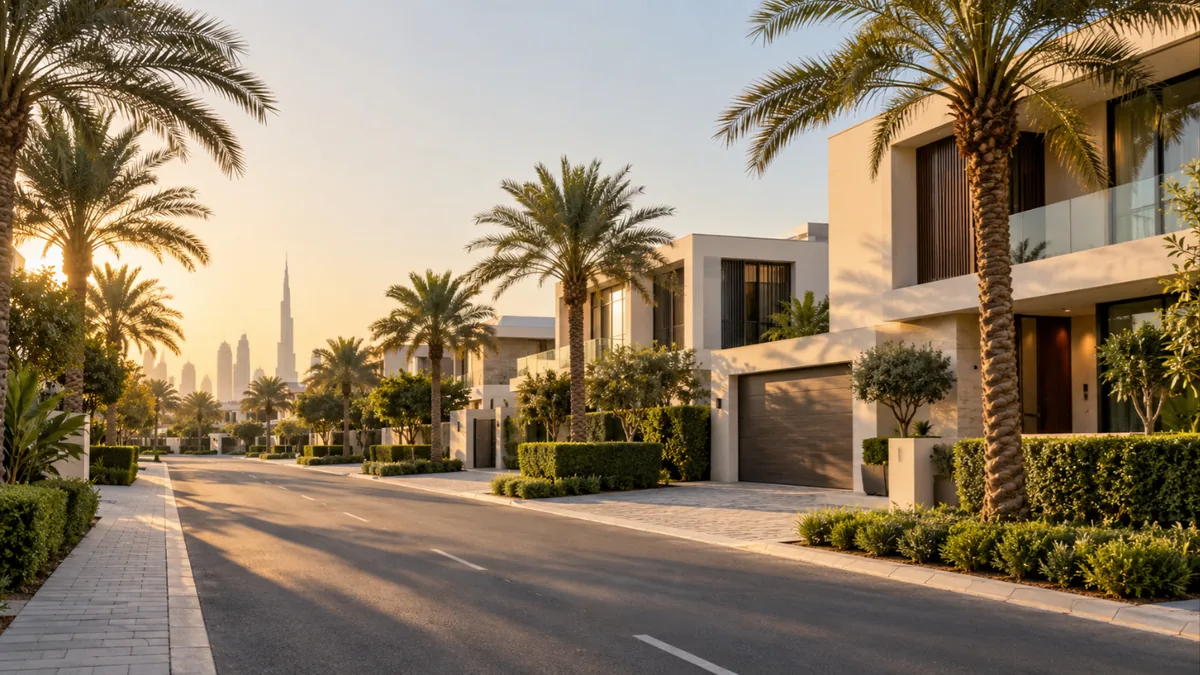
We are not tied to one factory or one range. We specify from European, Asian and Middle-East mills according to what the room needs and what the budget allows, and we fit what we supply so there is one company responsible for the whole floor. Every image on this page is an illustration of the style, not a photograph of a client’s home.
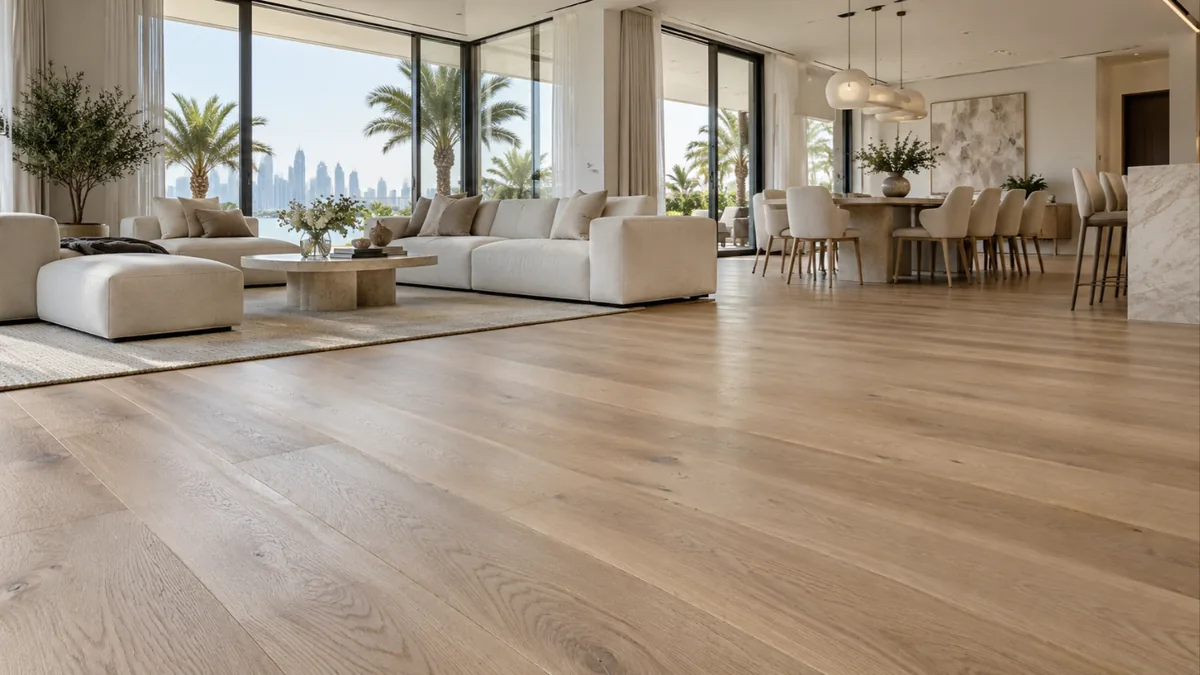
Our default recommendation for Dubai. A real hardwood wear layer of 3–6 mm over a cross-bonded core, in widths from 150 mm to 300 mm and lengths up to 2.5 m, brushed, smoked, fumed, white-oiled, natural or colour-matched to your joinery. Stable under air conditioning, suitable over underfloor heating, and sandable two or three times over its life.
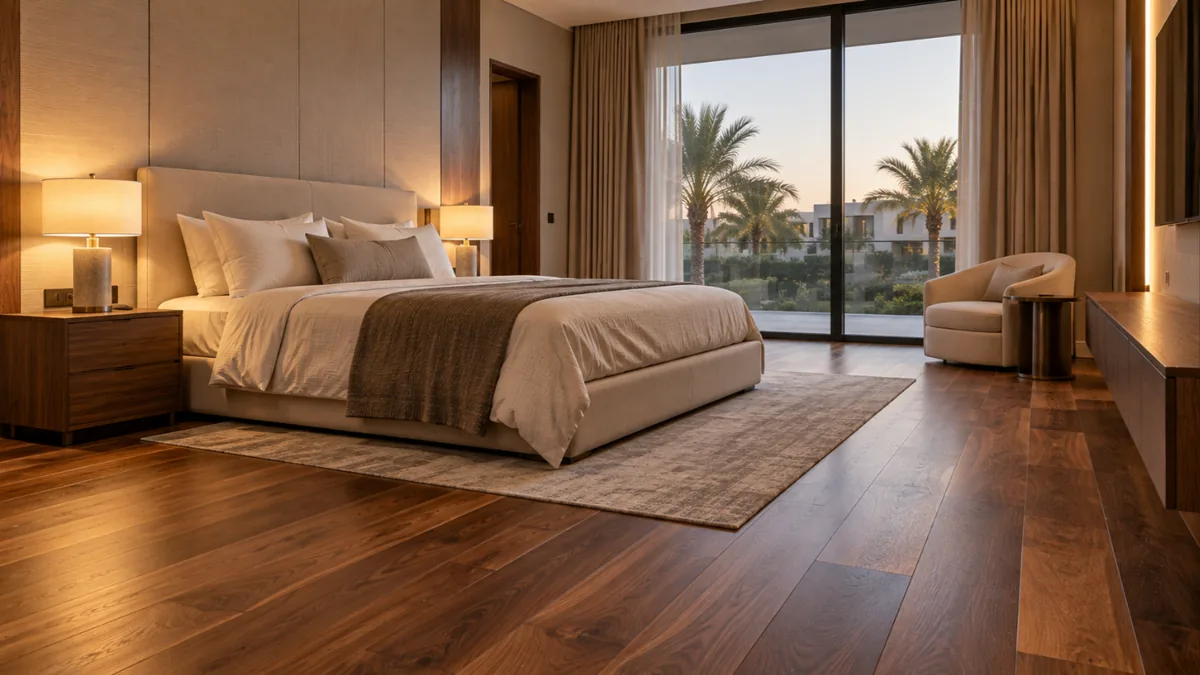
Solid oak, walnut, teak, iroko and merbau in strip and plank widths, secret-nailed or fully bonded on a suitable subfloor. The right choice where a floor must last generations and be refinished many times, and in properties where humidity is steady. We advise narrower widths and acclimatisation on site before laying.
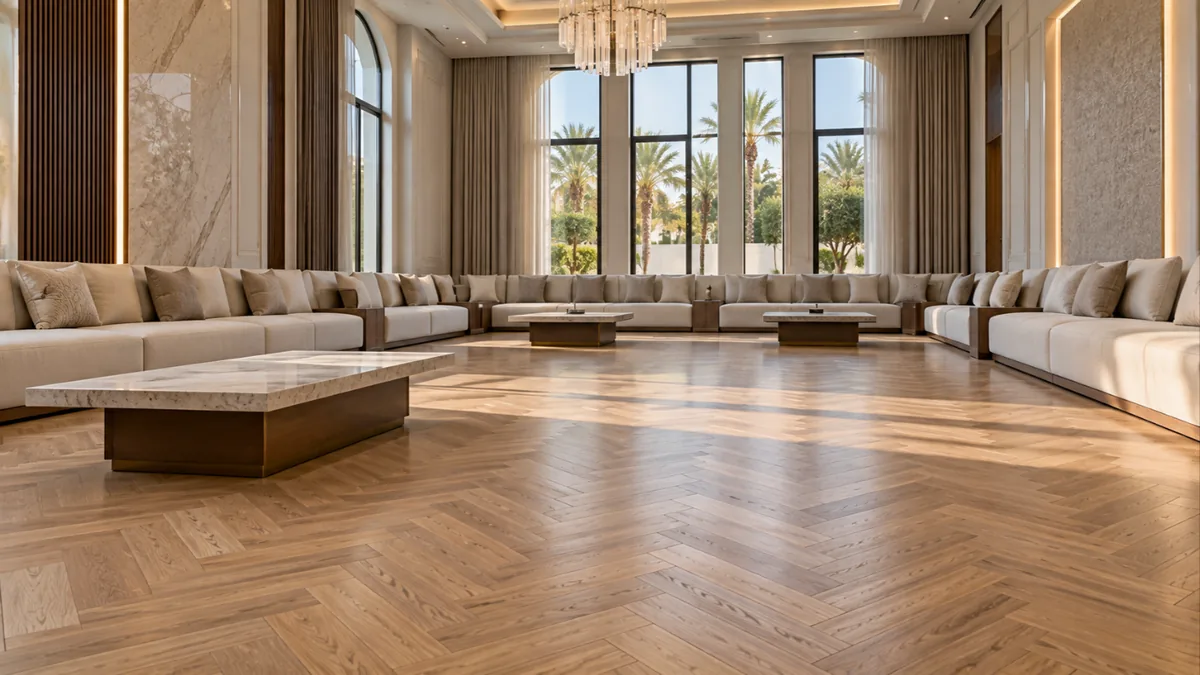
Classic blocks and modern large-format herringbone, 45° and 60° chevron, Versailles and Chantilly panels, and borders or inlays that frame a majlis or a formal dining room. Set out from the centre line of the room so the pattern lands correctly at every wall, with a mitred border where the design calls for one.
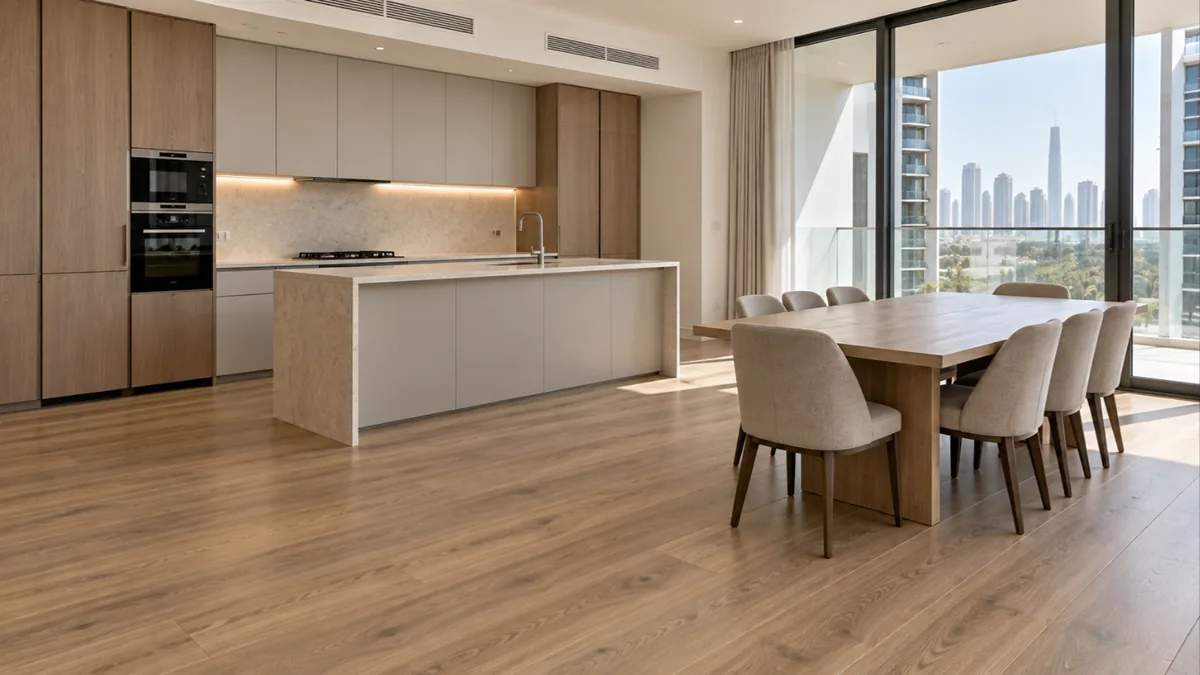
For rentals, apartments with strict acoustic rules, kitchens, gyms, children’s rooms and anywhere water is a real risk. Rigid-core SPC and glue-down LVT are fully waterproof, quiet with the right underlay and convincing at the top of the range; laminate remains the most cost-effective way to change a floor quickly. We fit these to the same standard of preparation as a timber floor.
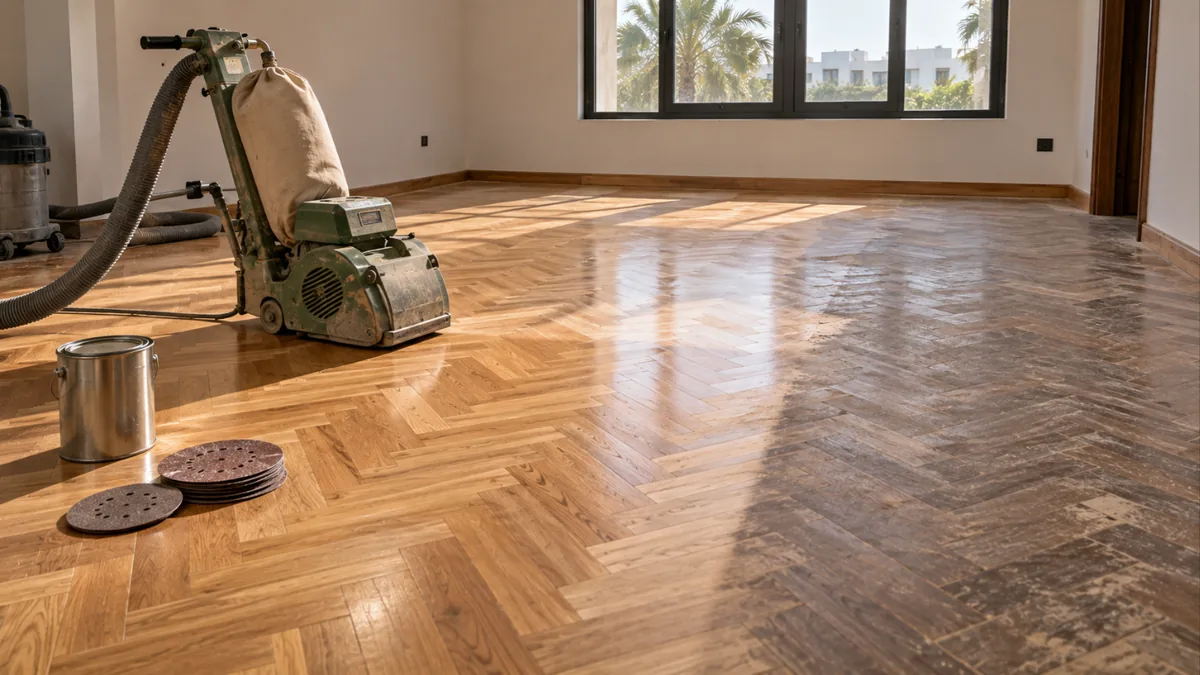
Dust-extracted sanding of existing parquet and plank floors, repair of damaged boards and blocks, re-staining to a new colour, gap filling, and re-finishing in hardwax oil or lacquer. A tired floor that still has wear layer left is usually far cheaper to bring back than to replace, and the work is done room by room so you can stay in the house.
Two floors that look identical in a showroom can behave completely differently after a Dubai summer. What matters is the core, the wear layer, the finish and how the board is fixed down. The table sets out what we specify and why.
| Option | Best For | Character | Notes for UAE Homes |
|---|---|---|---|
| Engineered oak, 4–6 mm wear layer | Living, dining, bedrooms, majlis | Real oak surface, any width | Our default; stable in dry AC air, sandable 2–3 times |
| Engineered walnut | Studies, master suites, feature rooms | Deep brown, rich figure | Softer surface — best away from sand at entrances |
| Solid oak strip and plank | Long-life floors, heritage-style rooms | Full-thickness hardwood | Narrower widths only; must acclimatise on site |
| Teak, iroko, merbau | Wet-prone rooms, terraces, boats | Oily, dense, warm colour | Naturally resistant to humidity and insects |
| Herringbone and chevron blocks | Formal rooms, majlis, entrances | Strong pattern, classic or modern | Needs a flat, dry substrate and careful set-out |
| Rigid-core SPC | Kitchens, gyms, rentals, apartments | Timber-look, fully waterproof | Dimensionally stable; excellent with acoustic backing |
| Glue-down LVT | Offices, showrooms, high-traffic areas | Thin, quiet, hard-wearing | Needs a very flat screed; fastest to repair in patches |
| Hardwax oil finish | Family homes, large areas | Natural, matt, tactile | Spot-repairable without sanding the whole room |
| Two-pack UV lacquer | Rentals, commercial, sunny rooms | Even sheen, tough film | UV inhibitors slow the colour change under glass |
| Acoustic underlay and DPM | Apartments and ground-floor slabs | Invisible but essential | Required by most Dubai building management rules |
Timber floors in the UAE face a peculiar combination: interiors held at 22°C and 40 per cent relative humidity for months, slabs that can still be releasing construction moisture, a summer where opening a door pushes 60 per cent humidity into the room in seconds, and fine sand carried in on every pair of shoes.
Dry air is the first problem. Timber gives up moisture to air-conditioned rooms and shrinks across the grain; a wide solid board can open a visible gap at every joint. We counter that by specifying engineered boards with cross-bonded cores for wide planks, by acclimatising every pallet in the property for several days before laying with the air conditioning running as it normally will, and by leaving correct expansion gaps at every wall, covered by the skirting rather than by a surface trim.
Slab moisture is the second. We take hygrometer or calcium-carbide readings before quoting a bonded floor and will not lay over a slab that is out of range — we fit a liquid damp-proof membrane or wait, and we say so in writing. Most catastrophic floor failures we are called to repair in Dubai come from a floor bonded to a slab that was never tested.
Sunlight is the third. Large windows and skylights bleach one part of a room and leave the rest untouched, which shows most on dark stains and on walnut. We recommend UV-inhibiting finishes, a colour chosen with that movement in mind, and — where a client cares about an even floor — solar film or blinds on the worst elevation. Finally, sand: it is abrasive, it is everywhere, and it is the actual cause of most worn finishes. Entrance matting inside and out does more for a floor than any product we can sell you.
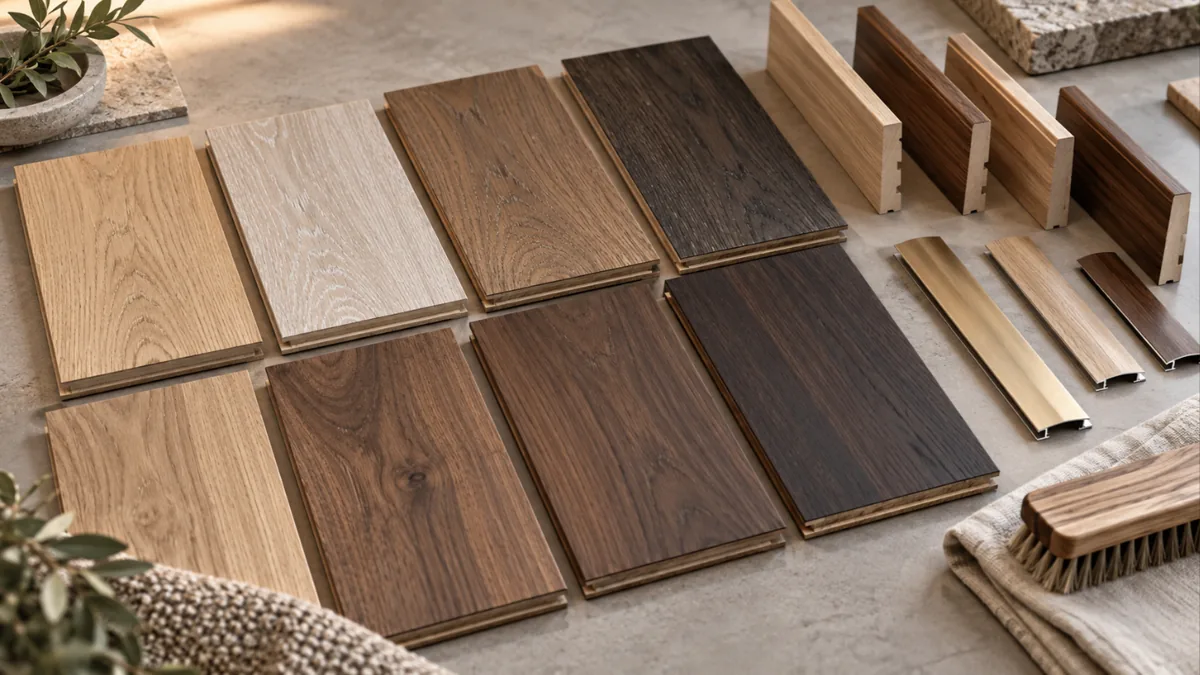
Colour is chosen in the room, never from a catalogue. We bring large samples — not postage stamps — and leave them on your floor for a day or two so you can see them in morning light, under your own lamps, and against your doors and kitchen. We supply natural, white-oiled, smoked, fumed, cerused, reactive-stained and colour-matched boards; brushed, hand-scraped, saw-cut and smooth textures; and matt, satin or natural-effect sheens.
Edges and transitions are where a floor is judged. We make matching skirtings in square, chamfered, bullnose and shadow-gap profiles; flush or recessed thresholds at bathrooms and terraces; stair nosings and landing boards cut from the same batch as the floor; and door bottoms trimmed and re-sealed so nothing binds. Where a floor meets marble, carpet or tile, we detail the junction with a brass, stainless or timber strip — or with no strip at all, which is harder to do and looks far better.
If you are planning underfloor heating, a fireplace hearth, a floor-level air conditioning grille or a floating vanity, tell us at the survey: all four change how the boards should be set out.
Our sequence is designed so that problems are found before boards are opened, not after they are glued down.
Flooring is usually priced per square foot or per square metre supplied and fitted, with preparation quoted separately because it depends entirely on the state of the slab. The ranges below are indicative 2026 figures from our own projects, excluding VAT. A typical 2,000 sq ft villa ground floor in mid-range engineered oak lands between AED 90,000 and AED 160,000 all in.
| Item | Typical Specification | Indicative Price (AED) |
|---|---|---|
| Engineered oak, supplied and fitted | 3 mm wear layer, 190 mm wide, oiled | 110 – 180 / sq ft |
| Premium engineered oak | 6 mm wear layer, 220–300 mm wide, brushed | 180 – 320 / sq ft |
| Solid hardwood, supplied and fitted | Solid oak or walnut strip, secret-nailed | 180 – 380 / sq ft |
| Herringbone or chevron parquet | Engineered blocks, bonded, set out | 170 – 340 / sq ft |
| Rigid-core SPC | 5–6 mm with acoustic backing | 45 – 90 / sq ft |
| High-pressure laminate | 8–12 mm, AC4/AC5 | 30 – 65 / sq ft |
| Sanding and re-finishing | Dust-extracted, three coats | 25 – 55 / sq ft |
| Self-levelling and preparation | Compound, primer, labour | 12 – 35 / sq ft |
| Liquid damp-proof membrane | Two-coat epoxy DPM | 10 – 22 / sq ft |
| Matching skirting | MDF or hardwood, painted or veneered | 45 – 130 / linear m |
| Stair nosings and landing boards | Cut from the floor batch | 200 – 600 / step |
| Lifting and disposal of old floor | Tile, carpet or old timber | 12 – 30 / sq ft |
| Factor | Engineered wood | Solid hardwood | SPC / LVT | Porcelain tile |
|---|---|---|---|---|
| Stability in AC air | Excellent | Fair — moves across grain | Excellent | Excellent |
| Wide planks possible | Yes, up to 300 mm | Risky above 150 mm | Yes | Yes |
| Water tolerance | Splashes only | Splashes only | Fully waterproof | Fully waterproof |
| Warmth and sound | Warm, quiet | Warm, quiet | Warm, quiet with underlay | Cold, echoes |
| Refinishing | 2–3 times | Many times | No | No |
| Over underfloor heating | Yes | Limited | Yes | Yes |
| Indicative cost | Medium–high | High | Low–medium | Low–high |
| Repair of one damaged area | Board replacement | Board replacement or sand | Plank swap | Tile cut out |
In practice we specify engineered oak for the main living areas of most Dubai villas, solid hardwood where a client wants a floor to outlive them and the room suits it, SPC or LVT in kitchens, gyms, laundries and rental units, and tile in bathrooms and terraces. Mixing materials is normal — what matters is that the junctions are detailed properly, which is exactly the part a joinery workshop is equipped to solve.
Wood floors here are damaged by three things: sand, standing water and the wrong cleaning product. Put a coarse mat outside and a soft one inside every external door, and vacuum with a soft brush head at least twice a week — grit is what actually scratches a finish. Clean with a barely damp microfibre mop and a pH-neutral wood floor cleaner; never a wet mop, never steam, and never a general-purpose or vinegar-based cleaner, all of which dull a finish and can lift a joint. Wipe spills straight away, especially around dishwashers, fridges and bathroom doorways, and check appliance connections once a year — almost every serious water-damage claim we see started under a machine. Use felt pads under every chair and table leg and re-check them twice a year. Keep blinds or solar film on the sunniest elevation if you want an even colour. Re-oil an oiled floor every one to two years in busy rooms and expect a lacquered floor to need a refresh every five to eight years; both are routine and we quote them room by room. Keep the spare boards we leave you — matching a batch years later is difficult, and a single damaged board is then a one-day repair.
Villa owners replacing developer tile or tired parquet with a floor that matches their joinery; families who want a warmer, quieter ground floor than marble; buyers of new-build villas who want the floor changed before they move in; apartment owners who need an acoustic build-up that satisfies building management; landlords who need a durable, waterproof floor between tenancies; owners of older Jumeirah and Umm Suqeim villas restoring original parquet rather than ripping it out; offices, clinics, showrooms and restaurants needing a floor that survives commercial traffic; and interior designers and contractors who need a subcontractor that will test the slab honestly and hit a programme.
Our workshop and stores are in Ras Al Khor Industrial Area, so most of Dubai is within thirty minutes for surveys, deliveries and installation crews. We regularly fit floors in Jumeirah, Umm Suqeim, Al Barsha, Arabian Ranches, Emirates Hills, Dubai Hills Estate, DAMAC Hills, Jumeirah Golf Estates, Jumeirah Park, Al Furjan, Mohammed Bin Rashid City, Palm Jumeirah, Dubai Marina, JLT, Downtown, Business Bay, Mirdif, Al Warqa, Nad Al Sheba, Town Square and Villanova, and on request in Sharjah, Ajman, Abu Dhabi, Al Ain and Ras Al Khaimah. Apartment work is planned around building rules, acoustic requirements, service-lift bookings and permitted working hours, and we handle the building management paperwork for you.
Floors are rarely specified alone. These pages cover the work that usually goes with them: staircases and balustrades so treads and landings match the floor; wall panelling and wooden ceilings for a matching wall and ceiling scheme; wooden doors and frames where door bottoms and thresholds meet the new floor; wardrobes and cabinets fitted over or around a floor; and the home carpentry hub, which lists every joinery service we offer.
Engineered, in almost every case. Its cross-bonded core resists the shrinkage that very dry air-conditioned air causes, so wide planks stay flat. Solid hardwood still suits narrower widths, stable rooms and floors you want to sand many times over decades.
Often yes. If the tiles are sound, well bonded and within flatness tolerance, we can prime and level over them, which saves the dust and cost of lifting. Loose or hollow tiles have to come up — we check by tapping the whole floor at the survey.
A typical 2,000 sq ft ground floor takes five to ten working days on site after preparation, plus three to seven days of acclimatisation before laying. Lifting an old floor or heavy levelling adds two to four days.
Not if it is specified for it. We acclimatise boards in the property with the AC running as normal, use engineered cores for wide planks and leave correct expansion gaps. Problems come from boards laid straight off the truck.
Always, before we quote a bonded floor. If readings are out of range we install a liquid damp-proof membrane or advise waiting. Most serious floor failures in Dubai start with an untested slab.
In a kitchen, yes — engineered boards with a well-sealed finish, or SPC where there is a real risk of standing water. In bathrooms we recommend tile, waterproof SPC or genuine teak detailed like a boat deck.
Engineered boards do, with the right thickness and a controlled warm-up schedule. Solid hardwood is limited. We coordinate with your heating installer on surface temperature limits before laying.
Usually, if there is enough wear layer left. We repair damaged blocks, sand with dust extraction, fill gaps, re-stain to a new colour if you want one, and re-finish. It is generally far cheaper than a new floor.
Hardwax oil for family homes and large areas, because scratches can be spot-repaired without sanding the room. Two-pack lacquer for rentals, commercial spaces and very sunny rooms, where a tougher film and UV inhibitors matter more.
Matching a batch later is difficult, which is why we leave spare boards from your own batch with every job. With spares, a damaged board is a one-day repair.
Yes — we make them in our own workshop from the same batch as your floor, including shadow-gap and flush profiles, thresholds, landing boards and stair nosings.
The manufacturer warranty on the boards plus our own written warranty on preparation, fitting and finishing. Terms, including what is excluded such as water damage from appliances, are stated on your quote.

Dubai’s single-source fit-out and renovation specialists since 1984. 25+ in-house trades delivering residential and commercial interiors across all seven emirates.
WhatsApp us