Fitout | Renovation Dubai designs, manufactures and installs custom TV units Dubai residents and businesses actually want to live with — floor-to-ceiling media walls, floating consoles, fluted feature panels and full library-style entertainment joinery. Everything is measured on site, built in our own Ras Al Khor workshop, and installed by our in-house carpentry teams across all seven emirates. No flat-pack. No gaps at the skirting. No trailing cables.
A television is the one object almost every living room is arranged around, and it is also the ugliest thing in the room. A well-made media wall solves that problem permanently. It hides the cables, holds the soundbar, swallows the receiver and the router, gives the screen a proper background instead of a bare painted wall, and turns a piece of electronics into an architectural feature. That is joinery work — not furniture shopping.
This page covers what we build, what it costs in AED, the materials that survive Dubai’s climate, how we handle ventilation and cable routing, and the areas across the UAE where our installation teams work. If you already have a drawing or a mood board, send it on WhatsApp to 050 366 5746 and we will come back with a measured quotation.
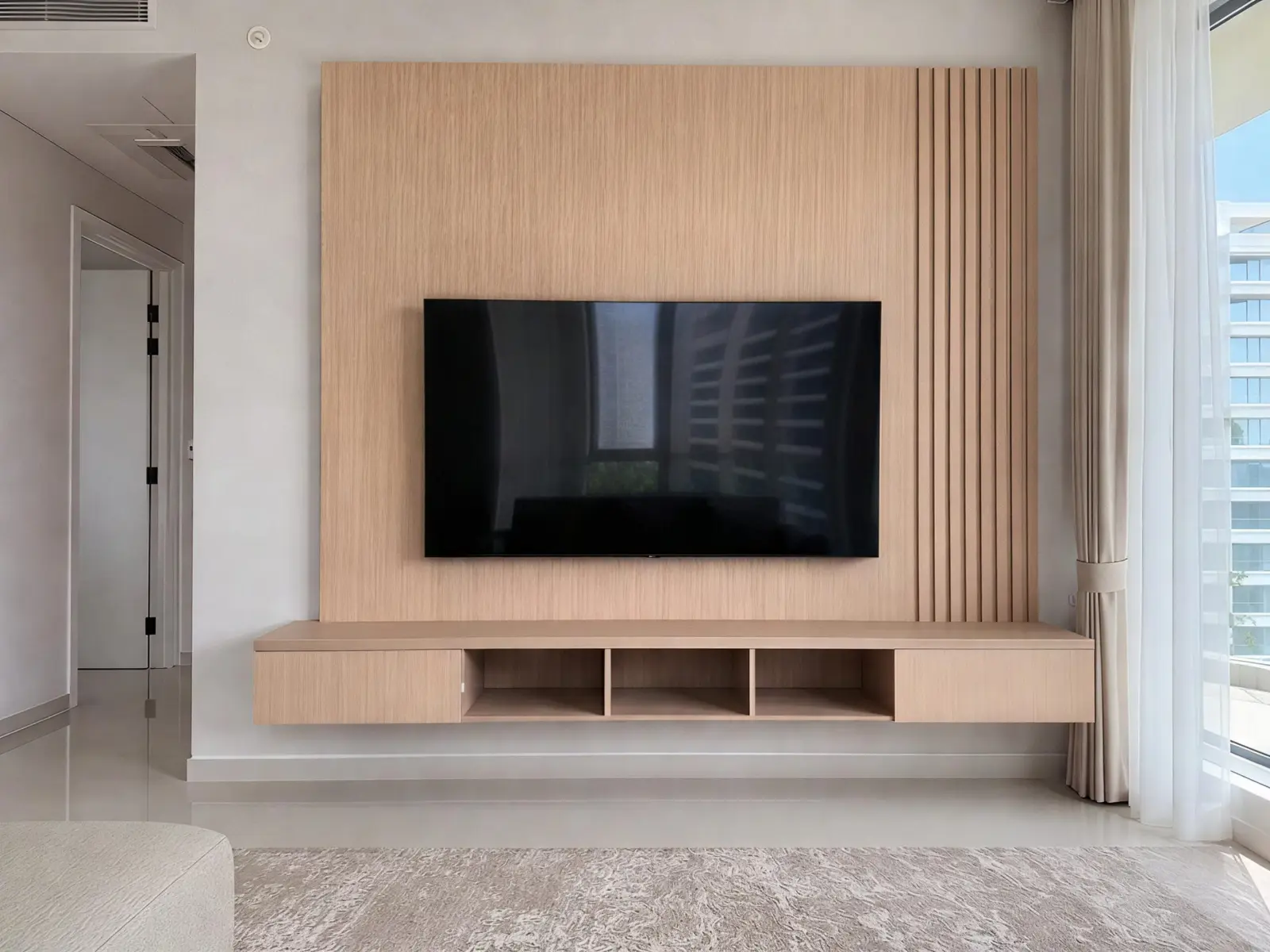
A bespoke TV unit is a made-to-measure cabinet or console built specifically for one wall in one room. A media wall goes further: it is a full wall treatment that integrates the screen, storage, shelving, lighting and often the wall finish itself into a single continuous piece of joinery. In practice, the difference is scope rather than quality.
Most of the projects we deliver in Dubai fall into one of three depths:
Every one of these is drawn, cut, edged, assembled and finished as a project of its own. Nothing is pulled off a shelf and adapted.
Retail TV consoles are designed for an average European or American room. Dubai rooms are not average. Villa living rooms in Arabian Ranches, Al Barari or Jumeirah frequently run 5 to 7 metres wide with 3.2 metre ceilings, and a 1.8 metre shop-bought console simply looks lost against them. Apartment living rooms in Downtown, Dubai Marina and Business Bay have the opposite problem — every centimetre counts, and a standard-depth cabinet eats walking space.
There are practical reasons too, and they matter more than the aesthetics:
Handover conditions. Tenants and owners in leasehold or developer-managed communities often need a unit that can be removed cleanly at the end of a tenancy. We can build demountable media walls with concealed keyhole fixings for exactly that reason.
Below are the formats our Dubai clients request most often. Every one of them is fully customisable in size, finish and internal layout — treat these as starting points, not a catalogue.
A seamless, monolithic wall in a single sprayed colour, with the joins deliberately expressed as shadow gaps. This is the most contemporary format we build and the most demanding to execute, because a flat lacquered surface hides nothing. Panel flatness, joint alignment and spray consistency have to be perfect. We finish these in two-pack polyurethane (PU) or Duco, in matt, satin or high-gloss, colour-matched to any RAL or NCS reference.
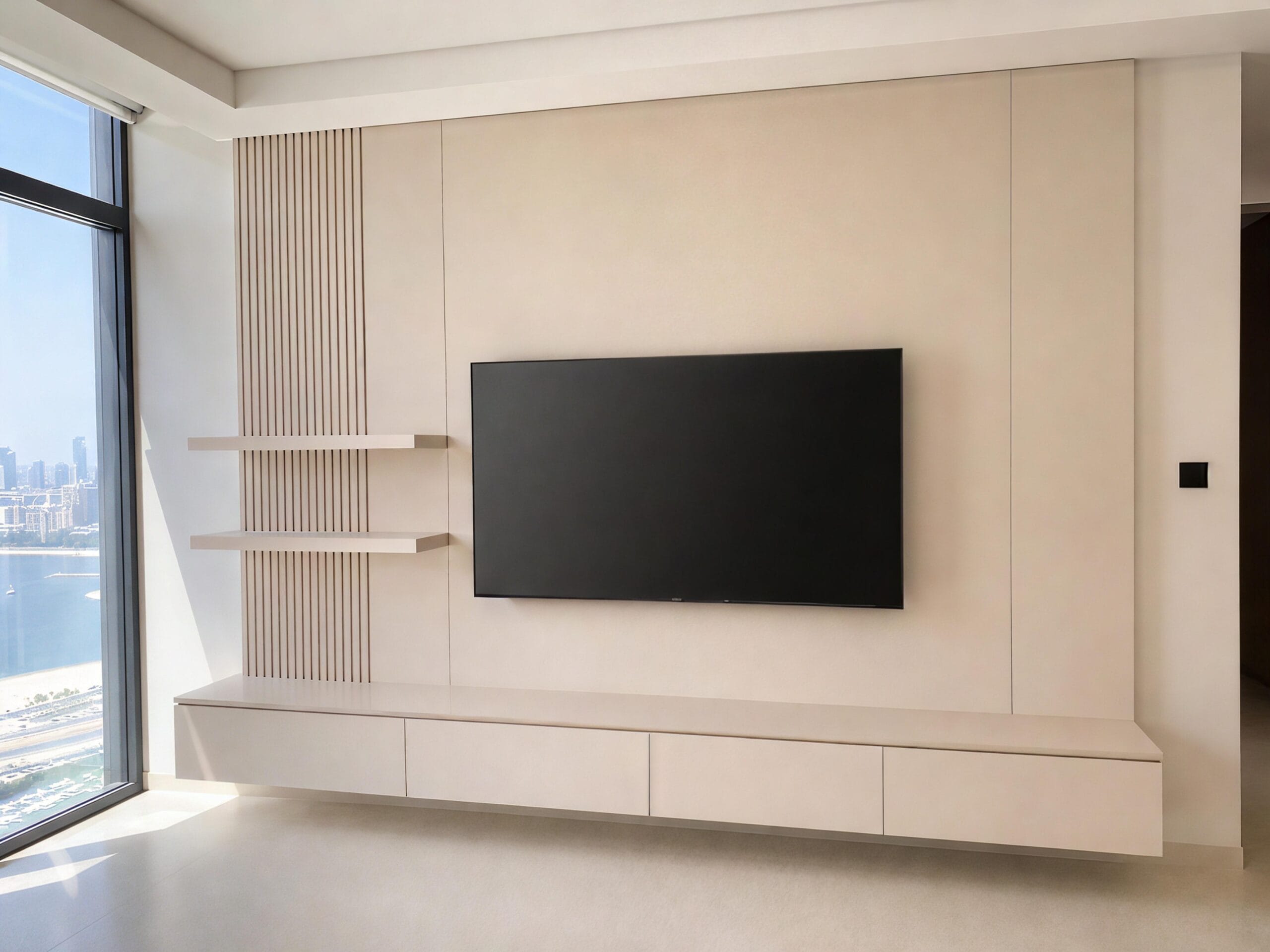
Vertical fluting has become the signature detail of contemporary UAE interiors, and it works particularly well on media walls because it breaks up a large flat surface without adding visual noise. We machine flutes in solid timber, MDF with lacquer, or veneered board, in half-round, square-edge, tapered and reeded profiles. Slat spacing is set to the wall dimension so you never end up with an awkward half-flute in a corner. Acoustic slat panels with felt backing are available where the room is echoey — a common issue in villas with marble or porcelain flooring.
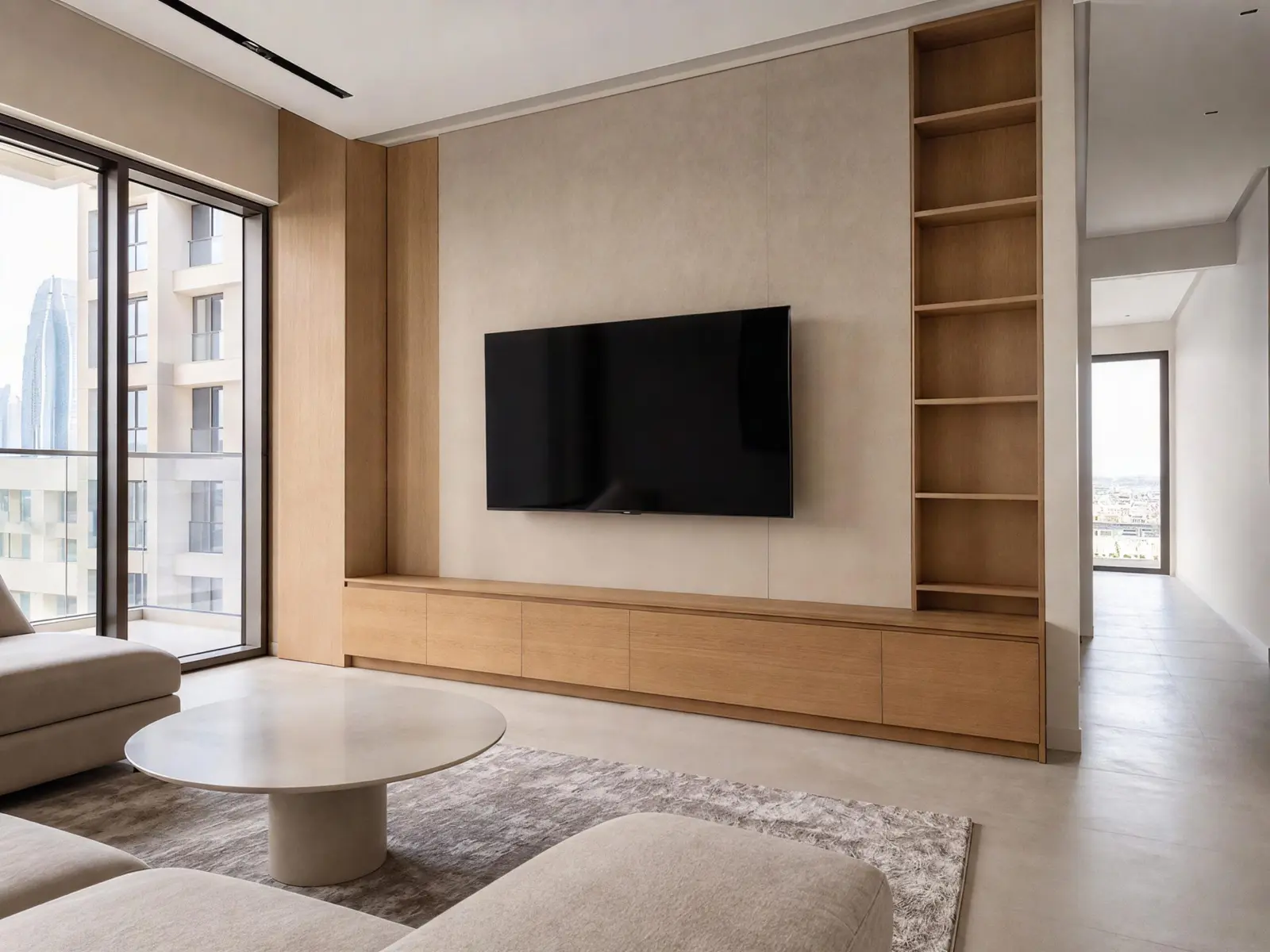
Natural timber veneer is still the most requested finish in Dubai villas. White oak, natural oak, smoked oak, American walnut and fumed ash are the perennials. The critical detail is grain matching: veneer leaves are sequence-matched across doors and panels so the grain runs continuously across the whole wall instead of restarting at every joint. It is invisible when done properly and glaringly obvious when it is not.
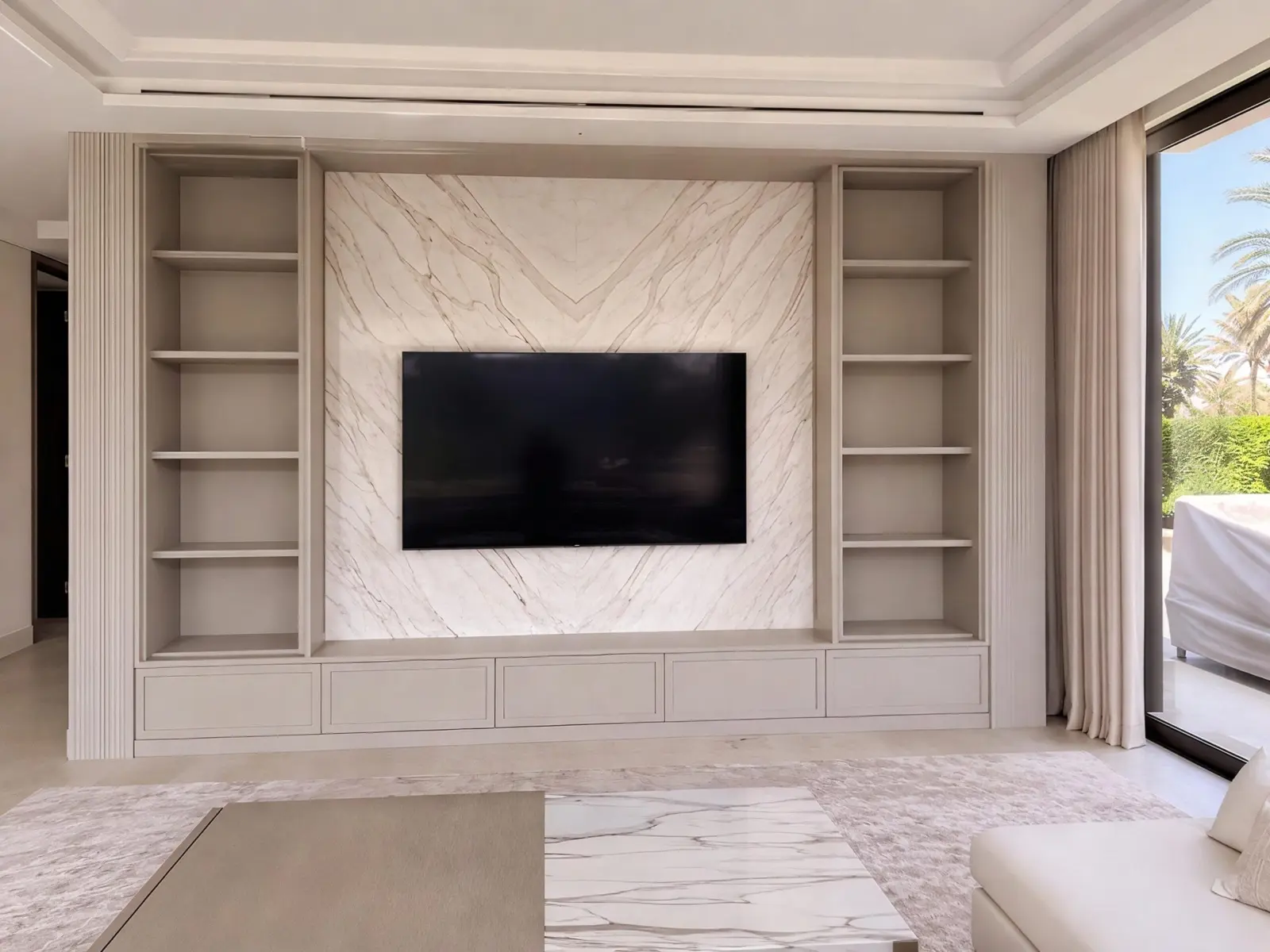
Where the client wants the screen framed by material rather than joinery, we set a bookmatched marble, quartzite or porcelain slab behind the television and build the cabinetry around it. Our stone division handles the slab selection, bookmatching, mitred edges and mechanical fixing; the carpentry division builds the substrate, the shadow-gap reveals and the base units. Because the screen is mounted through the slab, the mount position, cable cores and back-box must be set before the stone is cut — which is exactly why single-contractor delivery matters on this style.
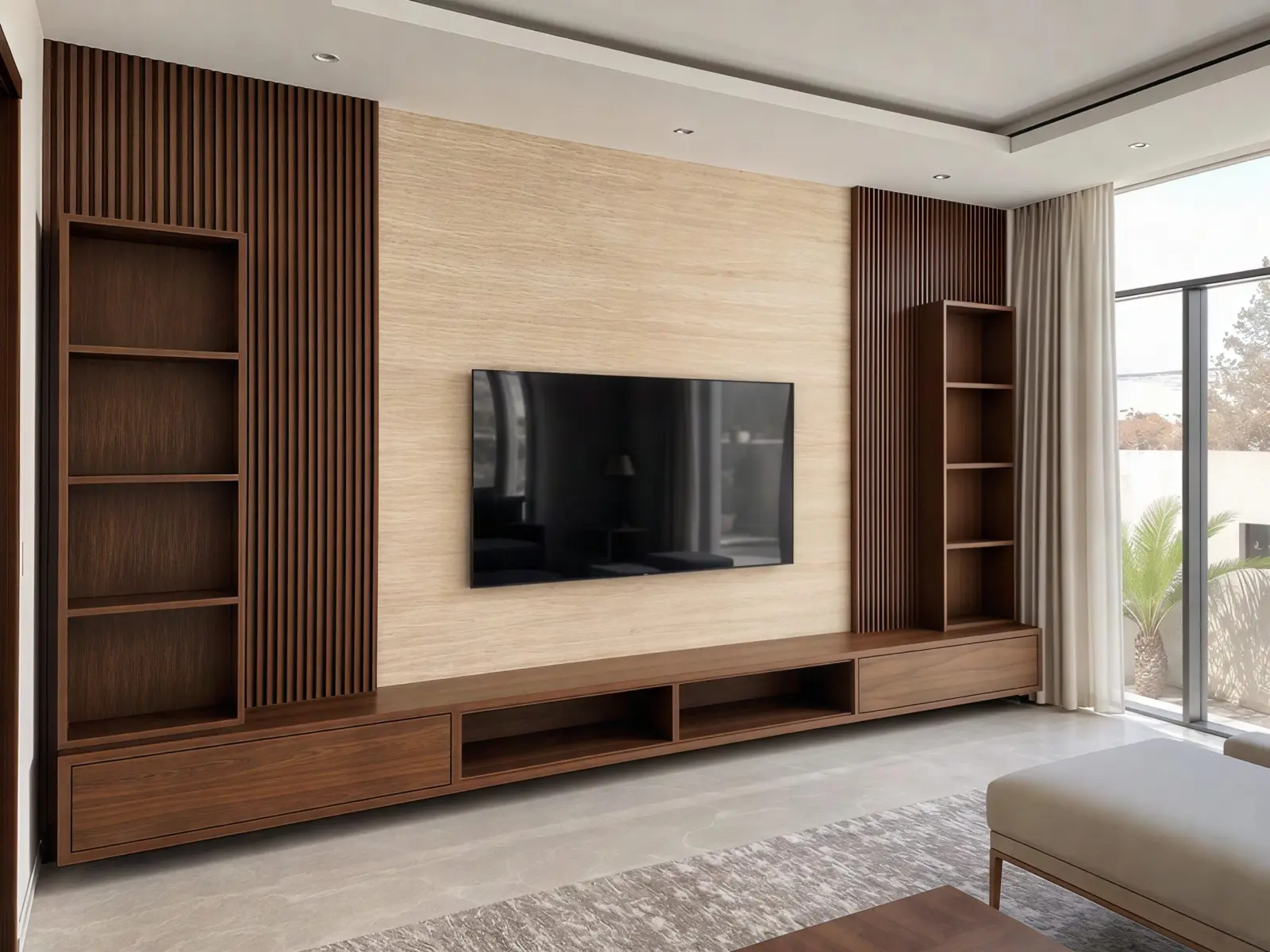
Deep, warm timber tones anchor a large living room in a way pale finishes cannot. We build these in walnut veneer, fumed oak, wenge-effect laminate or stained ash, usually combining a darker frame with a lighter central panel so the screen does not disappear into the joinery. Contrast is the trick: pair the dark timber with a travertine, microcement or light stone TV backdrop and the composition reads as intentional rather than heavy.
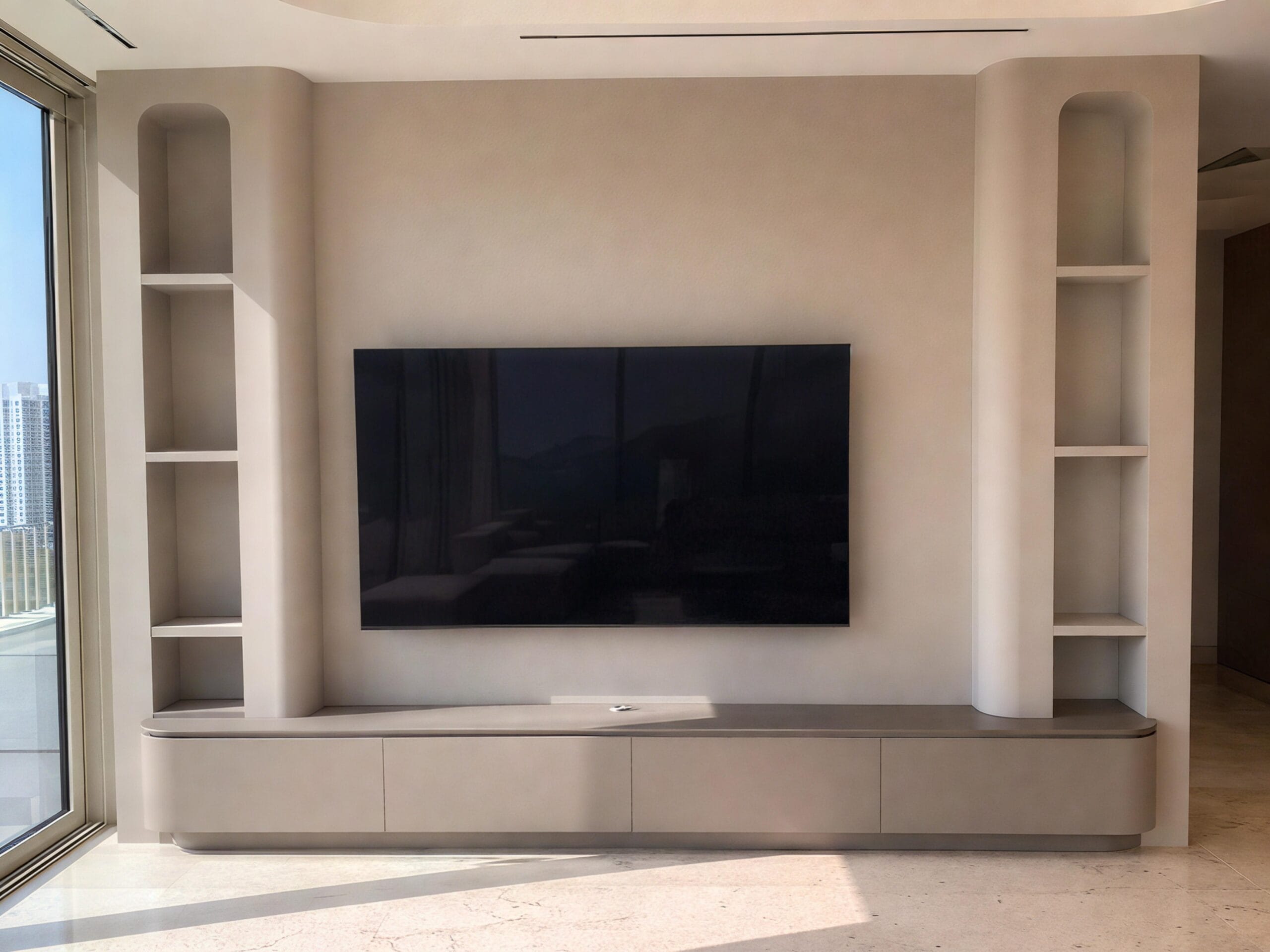
Curves are the hardest joinery to get right and the most striking when you do. Radiused corners, arched niches and bull-nosed carcasses have to be built up from flexible MDF over machined formers, then filled, faired and sprayed by hand. There is no shortcut and no supplier to buy it from — this is pure workshop carpentry. We build curved media walls in lacquer and in microcement over a timber substrate, with LED-lit arched display niches on either side of the screen.
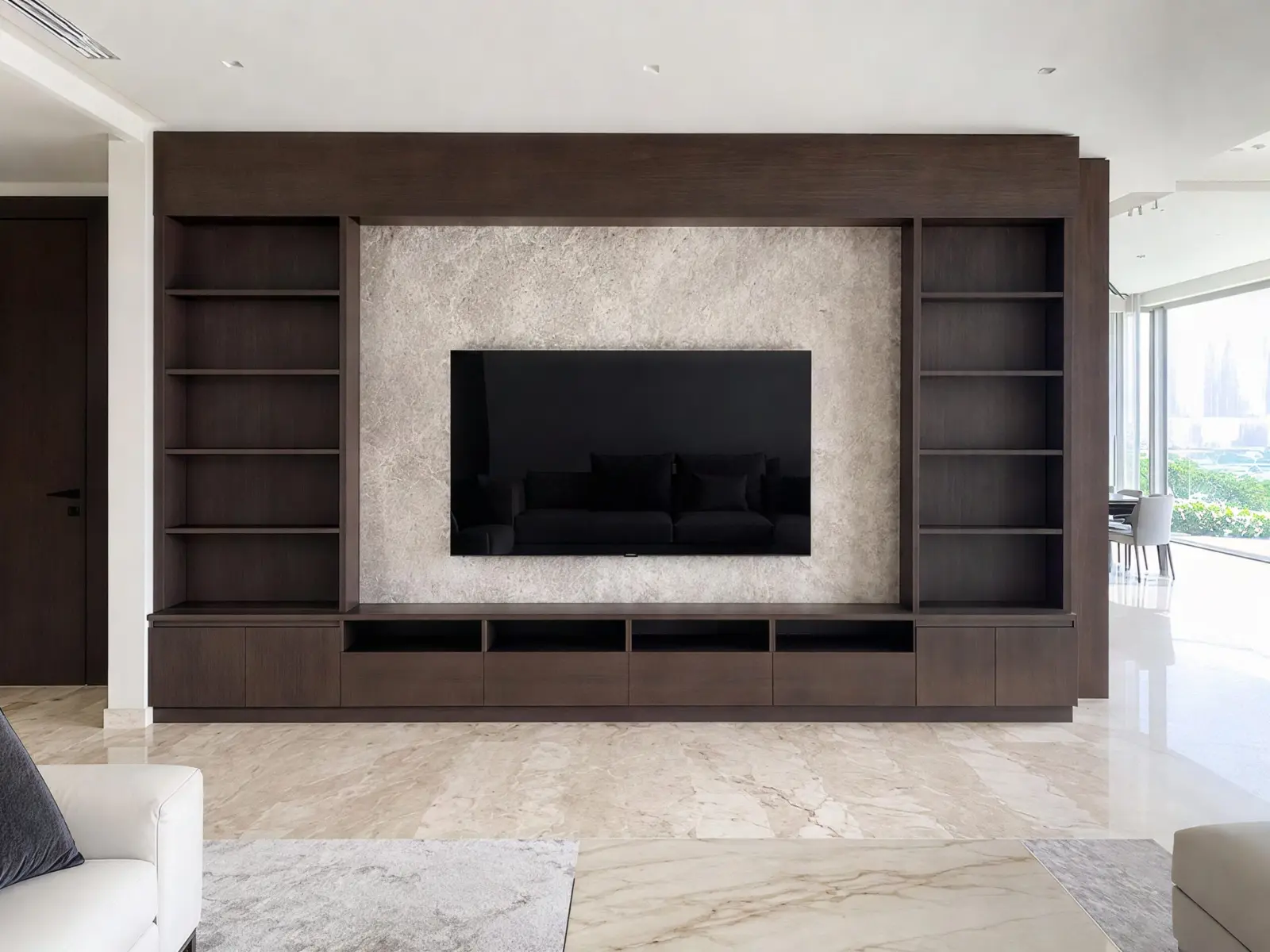
For clients who want the wall to do more than hold a screen, we build symmetrical shelving towers either side of the television with closed cabinetry below. This is the most useful format in a family villa: books, board games, awards, ceramics and the inevitable pile of remote controls all get a home. Adjustable shelves on concealed supports let the layout change over the years without drilling new holes.
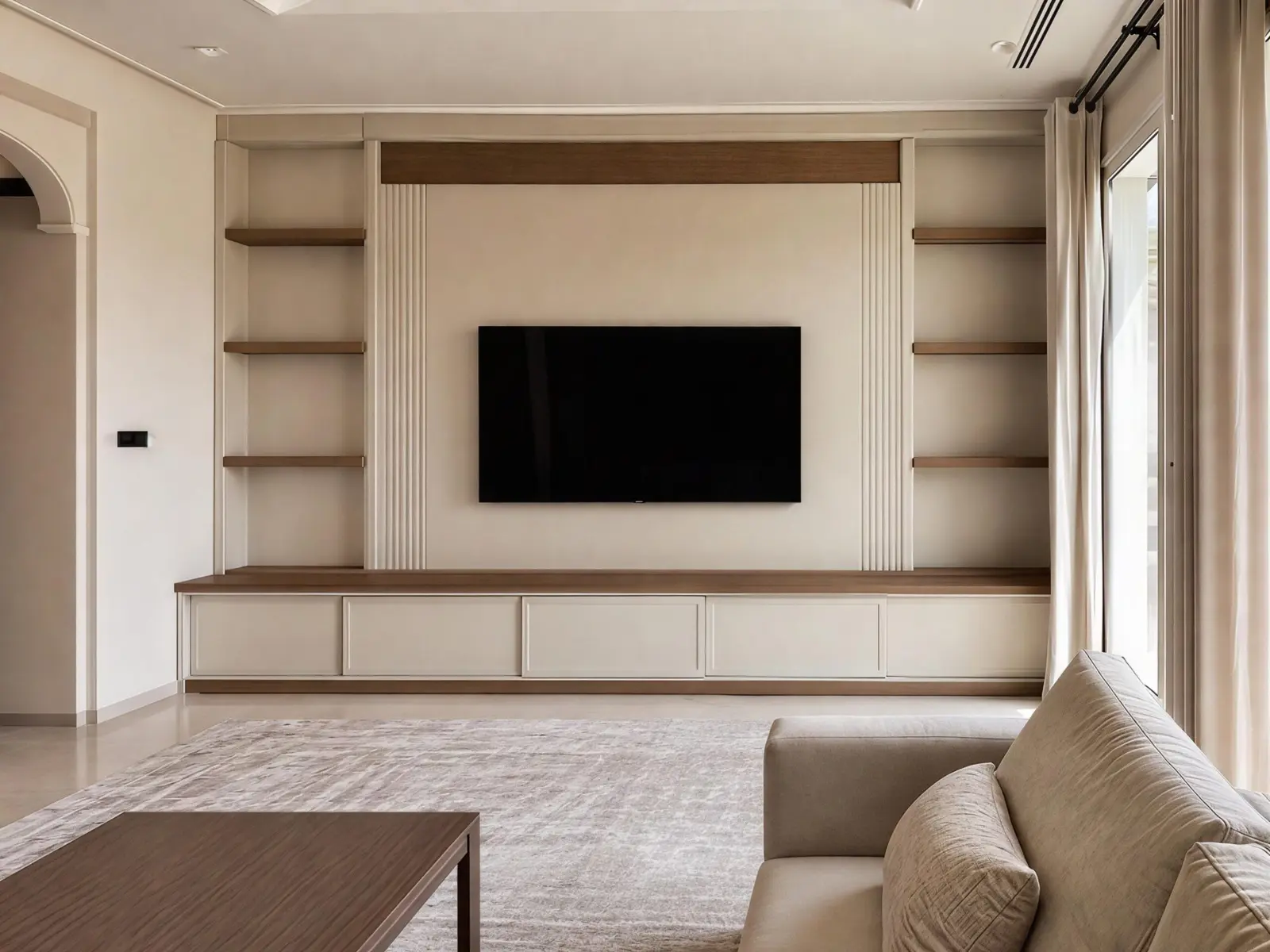
Painted framed panels, cornice returns, fluted pilasters and shaker-profile drawer fronts, usually in off-white or greige with walnut or oak accents. This style suits the Mediterranean and Arabic-classical villa architecture common in Al Furjan, Nad Al Sheba, Mirdif and Sharjah. We machine our own mouldings rather than buying stock profiles, so the proportions match the room’s existing cornice and skirting instead of fighting them.
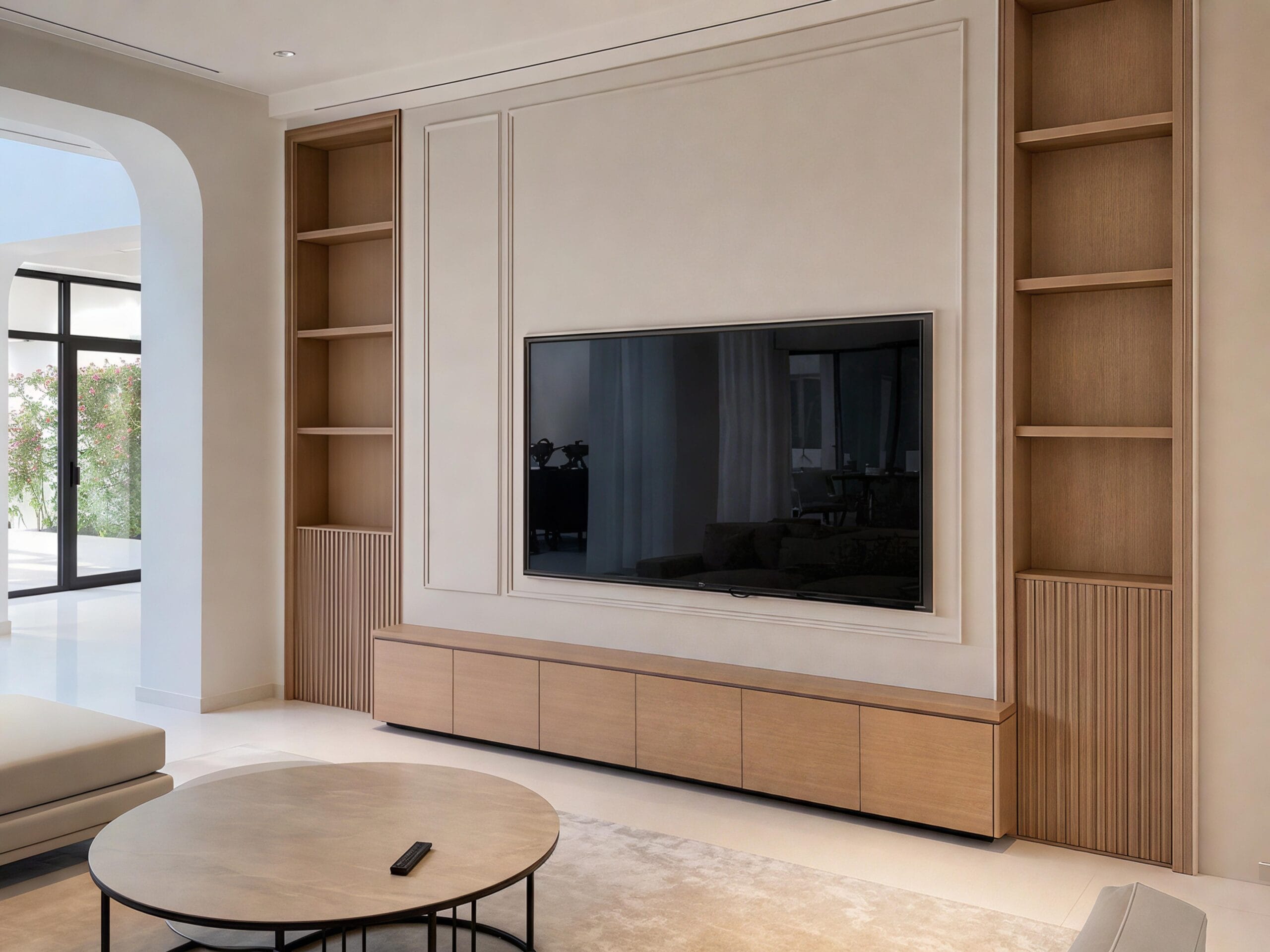
A hybrid format that has become very popular in Dubai villas: a painted panelled wall with a moulded recess sized precisely to the television, flanked by timber bookcase towers. The screen sits flush inside its frame, which makes a switched-off TV read as a framed picture rather than a black rectangle. The recess depth has to be set against the exact screen model and mount, so this one always needs the TV specification before we cut.
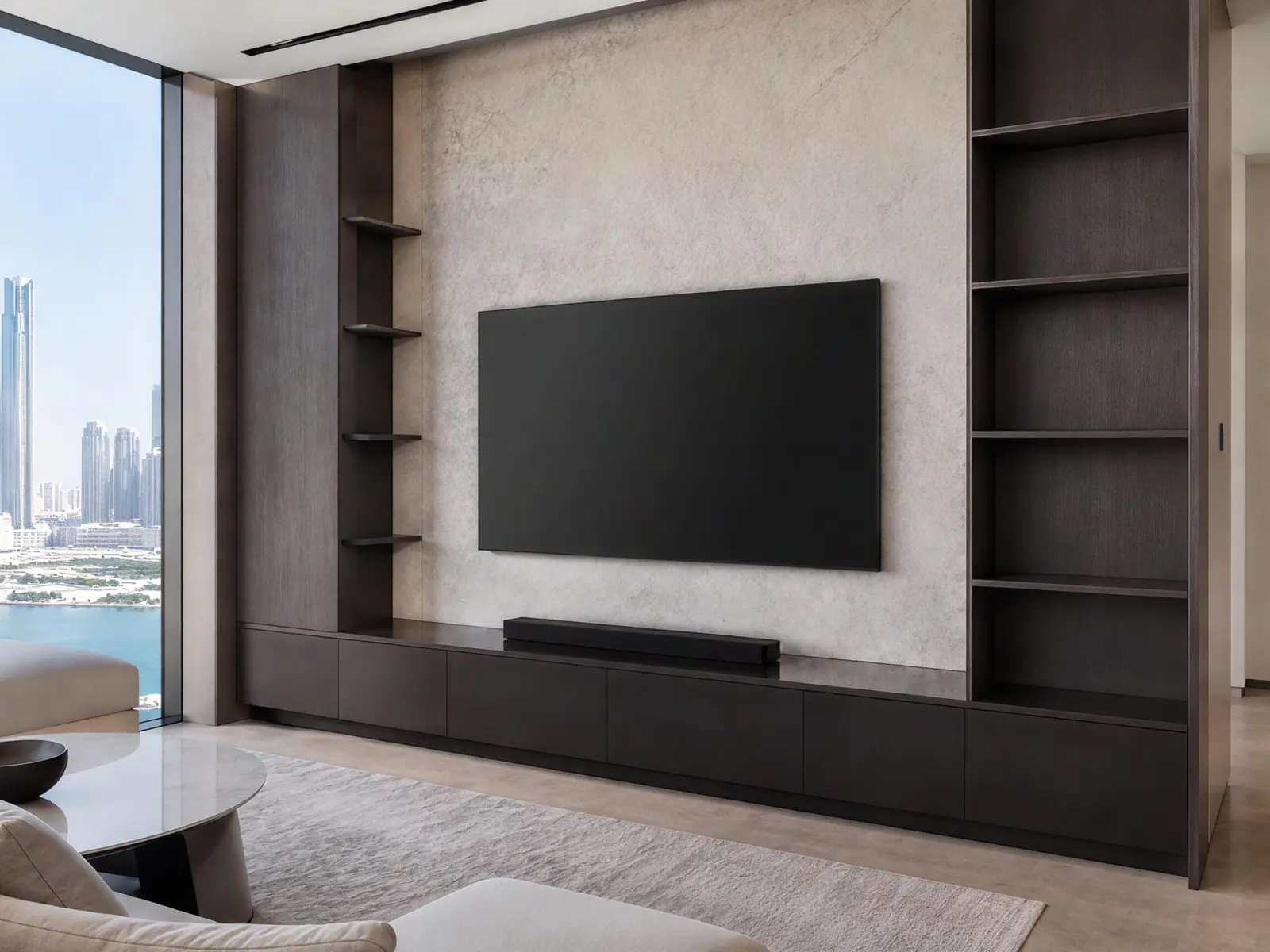
Charcoal, graphite and espresso finishes paired with a textured stone or microcement centre panel. This palette works beautifully in high-floor apartments where the window wall is doing all the visual work — the media wall recedes during the day and frames the screen at night. Integrated soundbar shelves, concealed ventilation slots and thin-profile corner shelves are standard on this format.
We specify Blum, Hettich, Hafele and Grass as standard — soft-close hinges, full-extension undermount runners, push-to-open mechanisms for handleless fronts, and heavy-duty adjustable shelf supports. Hardware is where cheap joinery fails first, usually within eighteen months, and it is the one line item we do not discount.
Anyone can build a box. The difference between a media wall that still works in year eight and one that fails in year two comes down to five details that are invisible on a mood board.
AV receivers, game consoles, set-top boxes and streaming devices all generate heat, and a sealed cabinet in a Dubai living room becomes an oven. We design passive convection into every enclosed AV compartment — low-level intake, high-level exhaust, minimum free area sized against the equipment load — and fit concealed slot vents or perforated back panels. Where the equipment load is heavy, we install thermostatically controlled quiet fans.
Cables are routed inside the joinery through vertical conduit chases from the TV mount plate to the equipment bay, with brush-plate exits and generous service loops. HDMI, power, network, satellite and speaker runs are kept separated to avoid interference. We plan for the cables you will add later, not just the ones you have today.
A large screen on a cantilever bracket applies serious leverage. We build a continuous timber or steel-reinforced mount plate behind the panel, fixed back to blockwork or structural studwork with chemical or expansion anchors sized to the screen weight — never into plasterboard alone. Floating consoles get a concealed steel sub-frame; we do not rely on the carcass or on brackets bought with the cabinet.
Every media wall we build has a removable panel or accessible route to the equipment and the mount. Sealing the electronics permanently inside a wall is a mistake that costs the client dearly on the day something needs replacing.
Recessed LED strip in shadow gaps, under shelves and behind the screen for bias lighting. We use constant-voltage 24 V drivers in accessible locations, dimmable and controllable, and we coordinate colour temperature with the room’s existing lighting so the joinery does not glow a different white to everything else.
For occupied homes we work around your schedule, and for buildings that require them we handle fit-out permits, access cards, contractor NOCs and building-management submissions ourselves.
Below are realistic supply-and-install ranges based on projects we have delivered across the UAE. Final pricing depends on wall dimensions, finish, hardware specification and site access. Every quotation we issue is fixed and itemised.
| Type of work | Typical size | Price range AED | Lead time |
|---|---|---|---|
| Floating TV console laminate / melamine | 1.8–2.4 m wide | 2,800 – 5,500 | 7–10 days |
| Floating TV console veneer or lacquer | 2.0–3.0 m wide | 5,500 – 11,000 | 10–14 days |
| TV back panel + floating console | up to 3.0 m wide | 9,000 – 18,000 | 12–16 days |
| Fluted / slatted feature TV wall | per m² of panel | 750 – 1,600 per m² | 12–18 days |
| Full-height media wall veneer | 3.5–5.0 m wide | 22,000 – 48,000 | 15–21 days |
| Full-height media wall 2-pack lacquer | 3.5–5.0 m wide | 26,000 – 58,000 | 18–25 days |
| Library-style media wall with shelving towers | 4.0–6.0 m wide | 32,000 – 75,000 | 20–28 days |
| Curved / arched media wall | 3.5–5.0 m wide | 38,000 – 85,000 | 22–30 days |
| Marble or porcelain TV backdrop supply & fix | per m² | 950 – 3,200 per m² | 10–18 days |
| Integrated LED lighting package | per media wall | 1,400 – 4,800 | with install |
| Cable management & AV enclosure works | per media wall | 900 – 3,500 | with install |
| Removal & disposal of existing TV unit | per unit | 350 – 900 | same day |
Prices are indicative and exclude VAT. Commercial, hospitality and multi-unit developer pricing is quoted separately — ask for our contract rates.
Clients often ask where the material actually comes from. We hold trade accounts with the established suppliers in the UAE market and can specify from any of them — or from a supplier you nominate.
Our installation teams work across the UAE, with the majority of our TV unit and media wall projects concentrated in Dubai.
Downtown Dubai, Business Bay, Dubai Marina, Jumeirah Beach Residence (JBR), Palm Jumeirah, Jumeirah 1/2/3, Umm Suqeim, Al Barsha, Al Safa, Al Wasl, Emirates Hills, The Springs, The Meadows, The Lakes, The Greens, The Views, Arabian Ranches 1/2/3, Dubai Hills Estate, Mohammed Bin Rashid City (MBR City), Damac Hills, Damac Hills 2, Dubai Sports City, Motor City, Jumeirah Village Circle (JVC), Jumeirah Village Triangle (JVT), Jumeirah Golf Estates, Al Furjan, Discovery Gardens, The Gardens, Dubai Silicon Oasis, Mirdif, Nad Al Sheba, Al Warqa, Al Khawaneej, Al Mizhar, Deira, Bur Dubai, Al Karama, Jaddaf, Culture Village, City Walk, Bluewaters Island, Dubai Creek Harbour, Dubai Islands, Dubai Land, Town Square, Tilal Al Ghaf, The Valley, Mudon, Serena, Remraam, Layan, Mira, Mira Oasis, Reem, Barsha Heights, Dubai Production City, Dubai Studio City, Jebel Ali, Dubai Investment Park (DIP), Ras Al Khor, Al Quoz and International City.
Abu Dhabi City, Al Reem Island, Saadiyat Island, Yas Island, Al Raha Beach, Al Raha Gardens, Khalifa City A & B, Mohammed Bin Zayed City, Al Reef, Masdar City, Al Bateen, Corniche, Al Maryah Island, Al Shamkha, Al Ghadeer, Al Ain and Al Dhafra.
Al Majaz, Al Khan, Al Nahda, Muwaileh, Al Qasimia, Al Taawun, Al Layyah, Tilal City, Al Zahia, Sharjah Waterfront City, Al Rahmaniya, Al Suyoh and Al Juraina.
Ajman Corniche, Al Nuaimiya, Al Rashidiya, Al Zorah, Emirates City, Al Salamah (UAQ), Al Raas, Al Hamra Village, Al Marjan Island, Mina Al Arab, Al Rams, Khuzam, Fujairah City, Dibba, Al Faseel and Sakamkam.
Site surveys inside Dubai are free of charge. Surveys in the Northern Emirates and Abu Dhabi are free for projects above AED 15,000 and otherwise carry a nominal travel fee that is credited back against your order.
For clients who want to check the regulatory and material standards behind our work:
A floating TV console typically costs between AED 2,800 and AED 11,000 depending on the finish, while a full-height media wall generally runs from AED 22,000 to AED 58,000. Library-style and curved media walls with stone, integrated lighting and extensive cabinetry range from AED 32,000 to AED 85,000. We issue a fixed, itemised quotation after a free site survey so there are no variations later.
Most projects are complete within three to five weeks from approval. Workshop manufacture takes 10–28 working days depending on the finish, and installation on site takes one to four days. Laminate and veneer work is quicker; two-pack lacquer, curved joinery and stone-integrated walls take longer because of the finishing and curing stages.
Yes — this is standard on every media wall we build. Cables run inside the joinery through internal conduit chases from the TV mount plate to a ventilated equipment bay, with brush-plate exits and service loops. Receivers, routers, consoles and set-top boxes sit in a compartment with proper airflow and IR pass-through or remote extenders so everything still works with the doors closed.
We build demountable media walls specifically for tenants. The unit is fixed with concealed keyhole plates or a top rail using a limited number of fixing points, so it can be removed at the end of a tenancy and the wall made good with minimal patching. Tell us at the survey stage that the property is rented and we will design accordingly.
Moisture-resistant MDF with a two-pack lacquer or a properly bonded natural veneer performs best in UAE conditions. Solid timber is used for machined details and edges rather than large panels, because it moves with humidity changes. We avoid low-grade chipboard and thin paper-foil finishes entirely — they delaminate within a couple of summers.
We mount the television and dress the cables as part of installation, using a bracket rated for your screen. We do not sell televisions, but we will confirm the exact mount, back-box and recess dimensions against your screen model before manufacture. If you plan to upgrade to a larger screen later, tell us and we will size the panel and mount plate for it now.
Yes. We bring physical samples to your home so colour and grain are assessed in your own lighting, and we can colour-match lacquer to any RAL, NCS or Pantone reference or to a physical sample you provide. For veneer, we sequence-match leaves across the whole wall so the grain runs continuously.
Yes. We handle fit-out permits, contractor NOCs, access cards, insurance documentation and building-management submissions ourselves. We are set up to work within developer and community regulations across Dubai, including DDA-governed and Dubai Municipality-governed areas.
All three are things we build regularly. Electric and bio-ethanol fireplaces need a specified clearance and non-combustible surround; aquariums need structural support and service access; hidden doors need a concealed pivot or jib-hinge system and careful reveal alignment. These are designed at drawing stage rather than improvised on site.
Yes. Every project includes elevations and a 3D visualisation so you can see proportions, finishes and lighting before manufacture begins. Revisions are included in the design stage — we would much rather change a drawing than rebuild a panel.
Twelve months on workmanship covering joints, finishes, alignment and installation, plus the manufacturer's warranty on hardware such as Blum and Hettich hinges and runners. Adjustments in the first few weeks after installation, as timber settles into the room's humidity, are free of charge.
Yes. We install across all seven emirates including Abu Dhabi, Sharjah, Ajman, Umm Al Quwain, Ras Al Khaimah and Fujairah. Site surveys within Dubai are free; surveys elsewhere are free on projects above AED 15,000.
Yes, removal and responsible disposal is available from AED 350 and is usually done on the first day of installation so there is no gap in the room.

Dubai’s single-source fit-out and renovation specialists since 1984. 25+ in-house trades delivering residential and commercial interiors across all seven emirates.
WhatsApp us